Top 7 Best Fireworks AI Alternatives & Competitors in 2026
A technical evaluation of the top 7 software tools matching the core capabilities of Fireworks AI. Compare side-by-side specifications, pricing models, and trade-offs.
Verified Technical Benchmarks•Updated September 2026•Category: data AI
Feature & Specification Comparison Matrix
Side-by-side technical capabilities, licensing, and pricing models.
World’s fastest AI inference delivering 2,000+ tokens/sec on Llama 3
4.9 / 5.0
Cerebras Inference is the world's fastest AI inference platform, powered by the revolutionary Cerebras CS-3 Wafer-Scale Engine (WSE-3). Delivering unprecedented speeds exceeding 2,100 tokens per second on Llama 3.1 8B and over 450 tokens per second on Llama 3.1 70B, Cerebras runs AI inference up to 20x faster than traditional NVIDIA GPU clusters.
By replacing traditional GPU memory bandwidth bottlenecks with 44 Gigabytes of on-chip SRAM across a monolithic silicon wafer, Cerebras achieves instantaneous response times that transform conversational AI, real-time code synthesis, and multi-step agentic reflection loops into fluid, zero-latency interactions.
Why Choose Cerebras Inference
Unmatched inference velocity: 2,100+ tokens/sec on 8B models and 450+ tokens/sec on 70B
Up to 20x faster than NVIDIA H100 GPU clusters with sub-10ms time-to-first-token
Extremely generous free tier (1,000,000 tokens free per day)
100% OpenAI API compatible with native streaming and function calling
Considerations & Limitations
Dedicated to open-weights models supported on the Wafer-Scale Engine
Context windows currently optimized for 8k–32k tokens depending on model architecture
Type-safe Python agent framework built by the creators of Pydantic
4.9 / 5.0
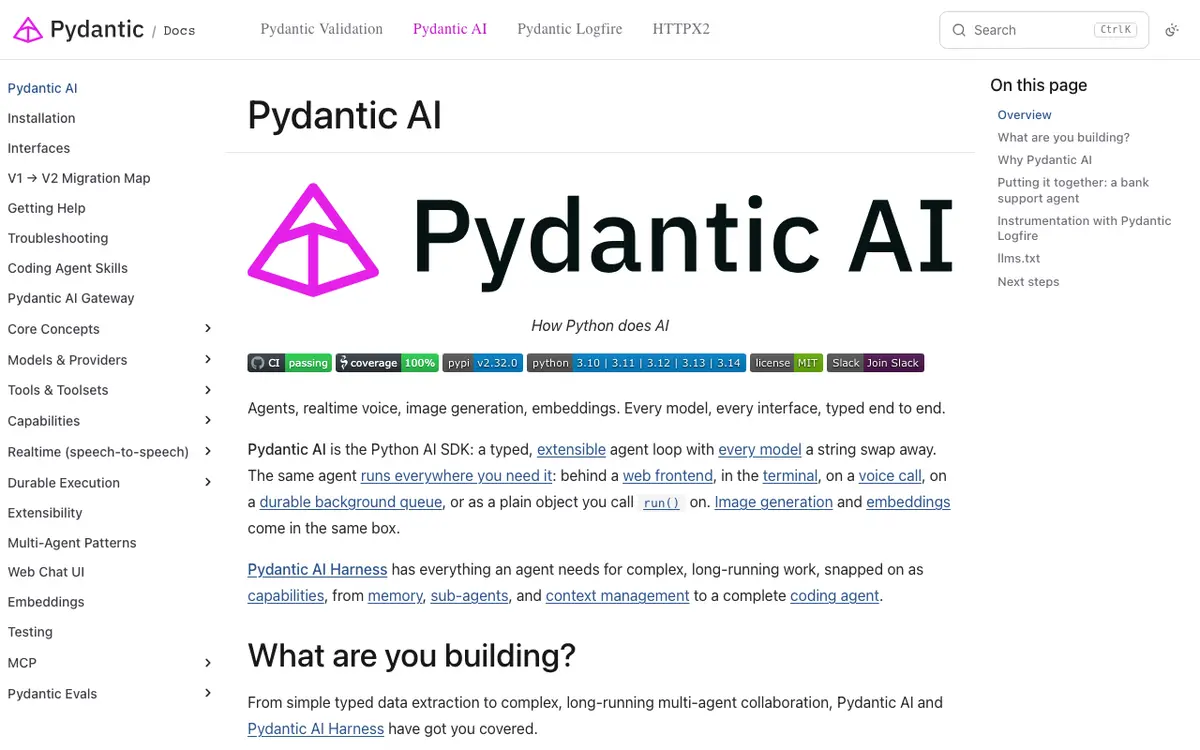
PydanticAI is a lightweight, production-grade Python agent framework created by the core Pydantic team. It brings strict type validation, structured outputs, and clean dependency injection to generative AI development, ensuring models strictly adhere to domain schemas.
Why Choose PydanticAI
Strict type safety and automatic validation for all model responses.
Zero vendor lock-in with unified interfaces across OpenAI, Anthropic, Gemini, and local SLMs.
Lightweight architecture with minimal dependencies compared to monolithic frameworks.
Native integration with Pydantic Logfire for granular observability.
Considerations & Limitations
Requires familiarity with modern typed Python (3.10+) and Pydantic v2.
Focuses on core agent primitives rather than pre-built UI components.
Decentralized compute platform and training framework for open AI models
4.9 / 5.0
Prime Intellect is a decentralized AI compute platform and distributed training infrastructure. It aggregates globally distributed GPUs into a unified cluster, enabling developers and researchers to train and fine-tune large-scale open AI models at up to 70% lower compute costs.
Why Choose Prime Intellect
Up to 50–70% cheaper GPU compute costs compared to traditional hyperscalers.
Fault-tolerant distributed training across globally distributed GPU clusters.
Instant serverless inference deployment with pay-per-token pricing.
Strong community backing open-source, decentralized frontier AI research.
Considerations & Limitations
Distributed training across multi-region nodes requires tuning for high-latency connections.
Spot instance pricing fluctuates based on global cluster demand.
Search API built specifically for AI agents & LLM retrieval
4.9 / 5.0
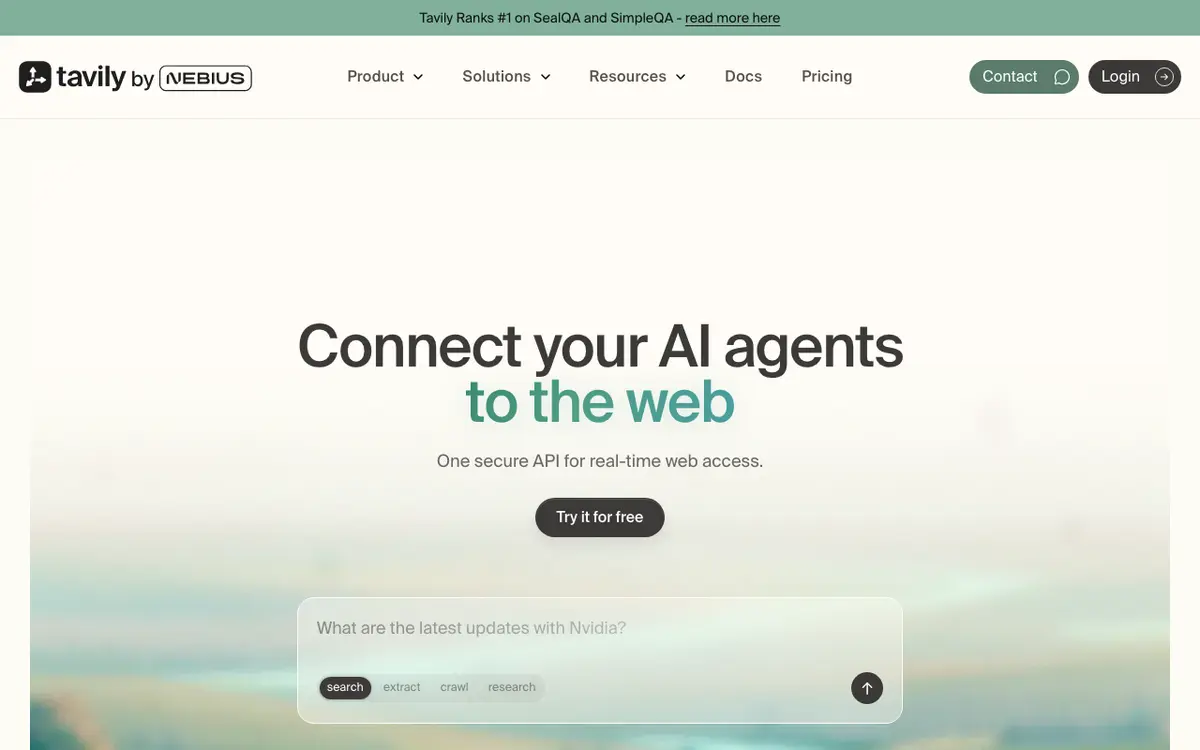
Tavily is a specialized search engine and API architecture designed from the ground up to power autonomous AI agents and Retrieval-Augmented Generation (RAG) pipelines. Unlike traditional consumer search engines designed to serve human-readable web pages packed with ads and banners, Tavily extracts clean, factual, and token-optimized Markdown and JSON data ready for direct LLM ingestion.
Developers using Tavily eliminate the complex, brittle pipelines of web scraping, HTML parsing, and ad stripping. Tavily queries hundreds of real-time web sources in parallel, evaluates domain credibility, and returns concise synthesized snippets alongside full source attribution in under one second.
Whether building an autonomous research assistant in LangChain, an automated market intelligence agent, or a real-time factual verification bot, Tavily serves as the definitive live information retrieval gateway for modern AI applications.
Why Choose Tavily
Built specifically for LLMs — returns clean Markdown/JSON with zero HTML noise
Sub-second API response latency optimized for streaming agent tool calls
Native integrations across LangChain, LlamaIndex, CrewAI, and AutoGen
Advanced domain inclusion and exclusion filtering for verified factual sources
Considerations & Limitations
API-first platform without a consumer-facing chat interface
Deep research queries consume multiple API credits per execution
High-performance vector database and similarity search engine for AI
4.9 / 5.0
Qdrant is an open-source, high-performance vector database and similarity search engine engineered in Rust for production AI systems, semantic search engines, and Retrieval-Augmented Generation (RAG) pipelines. It provides lightning-fast nearest-neighbor search with rich payload filtering and custom distance metrics.
Unlike traditional databases adapted for vectors, Qdrant was designed from day one to handle high-dimensional neural embeddings at scale. Its Rust engine provides memory-efficient vector quantization (scalar, product, and binary), allowing engineering teams to search billions of vectors on cost-effective cloud hardware.
Why Choose Qdrant
Engineered in Rust for blazing sub-10ms search latency and minimal memory footprint
Advanced vector quantization reduces RAM requirements by up to 90%