Top 7 Best Pipecat Alternatives & Competitors in 2026
A technical evaluation of the top 7 software tools matching the core capabilities of Pipecat. Compare side-by-side specifications, pricing models, and trade-offs.
Open-source real-time WebRTC infrastructure for building ultra-low-latency voice and multimodal AI agents
4.9 / 5.0
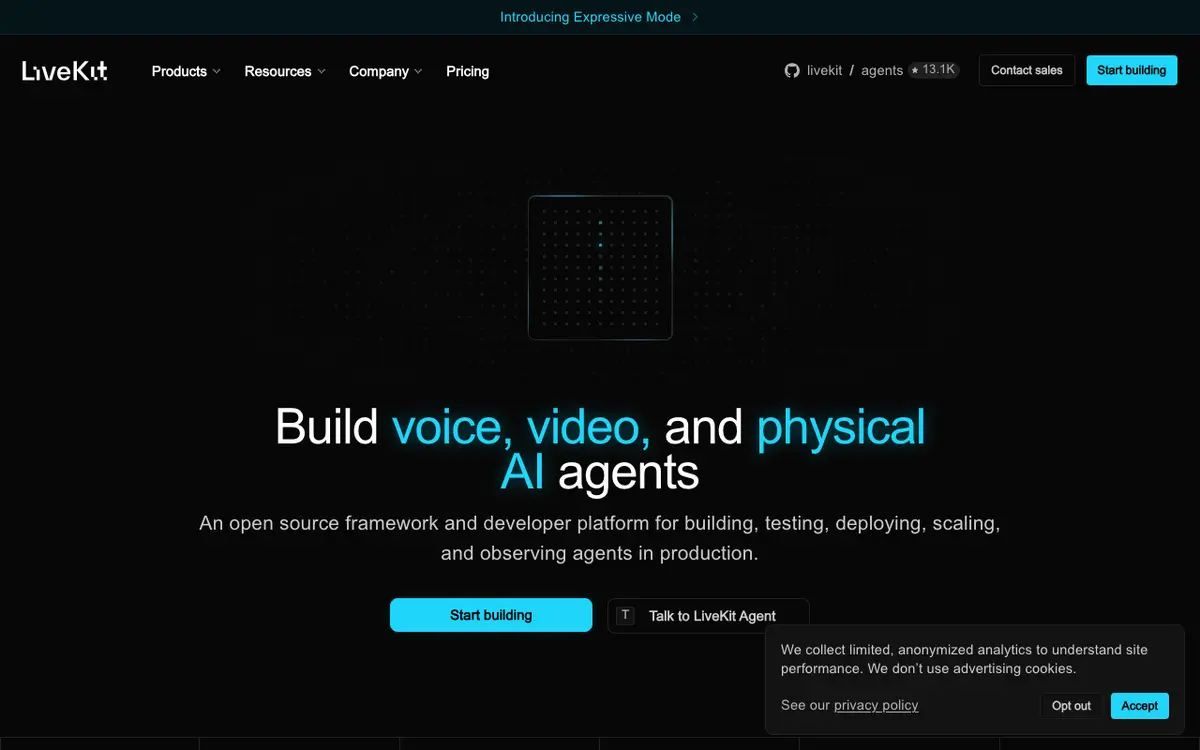
LiveKit Agents is an open-source real-time communication framework engineered to build conversational voice, video, and multimodal AI agents with sub-500ms latency. Leveraging WebRTC, it connects speech-to-text (Deepgram, Whisper), LLMs (OpenAI, Anthropic), and text-to-speech (Cartesia, ElevenLabs) in a tightly synchronized bidirectional stream.
From customer service avatars to interactive language tutors and hands-free coding copilots, LiveKit Agents provides the enterprise infrastructure for real-time human-AI interaction.
Why Choose LiveKit Agents
Ultra-low latency (<500ms voice response) with adaptive turn-taking and VAD
100% open-source core with comprehensive Python and Node.js SDKs
Native WebRTC transport ensures seamless connection across mobile and web
Considerations & Limitations
Requires software engineering expertise in backend streaming pipelines
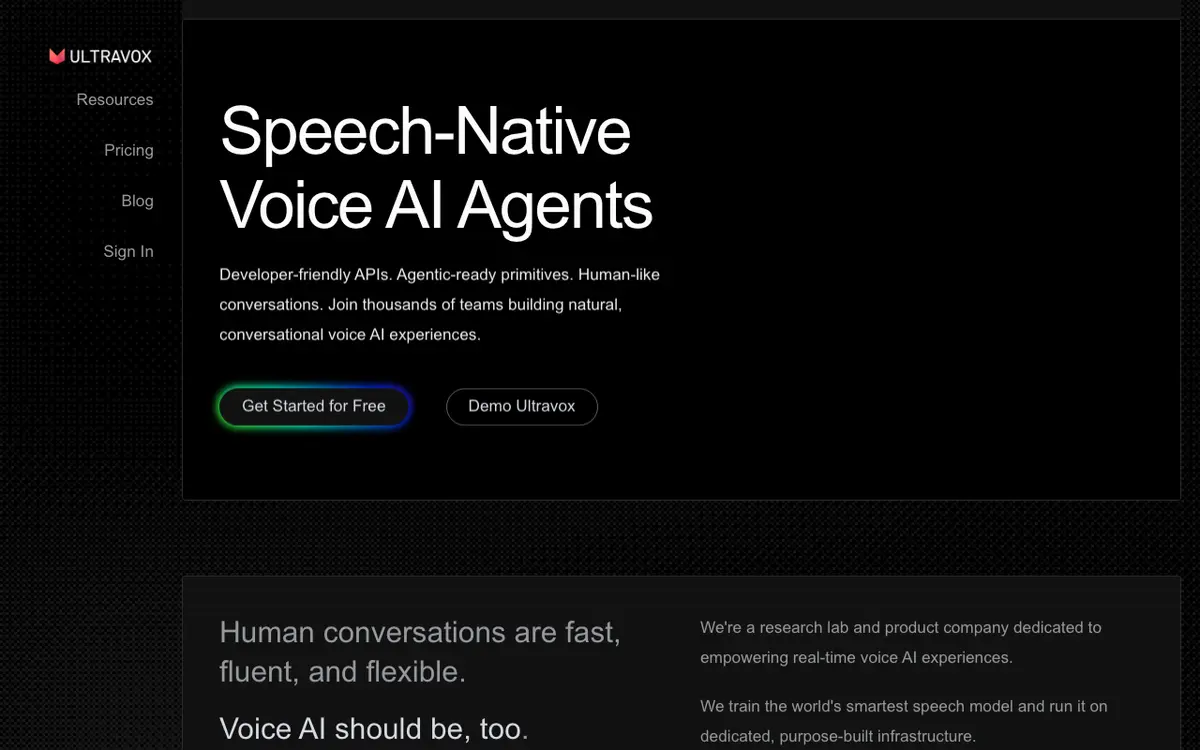
Ultravox.ai builds speech-native voice AI agents for real-time conversational interactions. It enables developers to integrate advanced voice capabilities into applications with low latency. The platform supports multiple languages and custom voice models for diverse use cases.
Ultra-low-latency real-time voice generation for AI agents
4.9 / 5.0
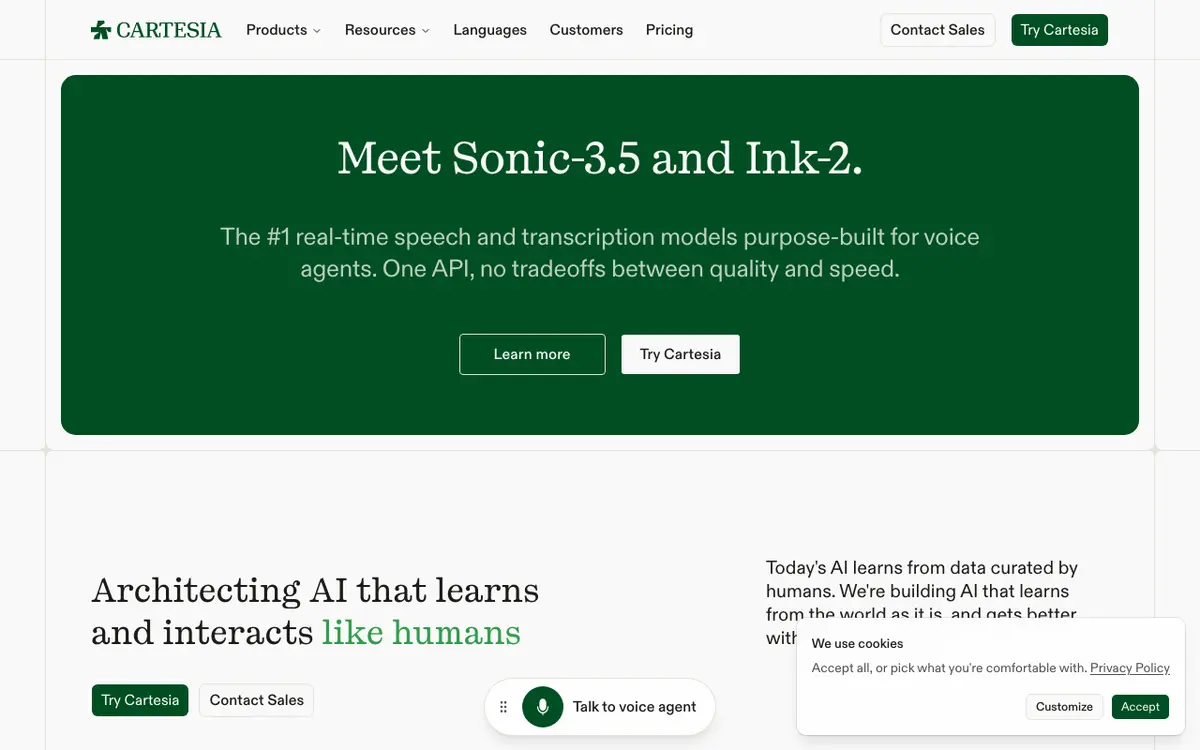
Cartesia is an AI audio and voice intelligence company that powers conversational AI agents and interactive applications with ultra-low-latency, hyper-realistic voice synthesis. Its flagship State Space Model (SSM) architecture, Sonic, delivers human-like voice generation with sub-90ms time-to-first-audio latency.
While traditional transformer-based text-to-speech models struggle with high latency and compute overhead, Cartesia's lightweight SSM architecture allows developers to build fluid, conversational voice bots that feel instantaneous and natural, without awkward pauses.
Cartesia is used by developers, contact centers, game studios, and AI agent builders across the world to power real-time phone assistants, gaming NPCs, live transcription translation, and voice-enabled enterprise interfaces.
Why Choose Cartesia
Ultra-low latency under 90ms — ideal for conversational voice agents
Instant zero-shot voice cloning from just a 5-second audio clip
State Space Model architecture yields superior efficiency and quality
Full WebSocket, REST, Python, and TypeScript SDK support
Considerations & Limitations
Primarily designed as an API-first tool for developers rather than non-technical creators
Requires streaming architecture knowledge to maximize low-latency performance
Real-time AI speech-to-text, text-to-speech, and voice agent API
4.9 / 5.0
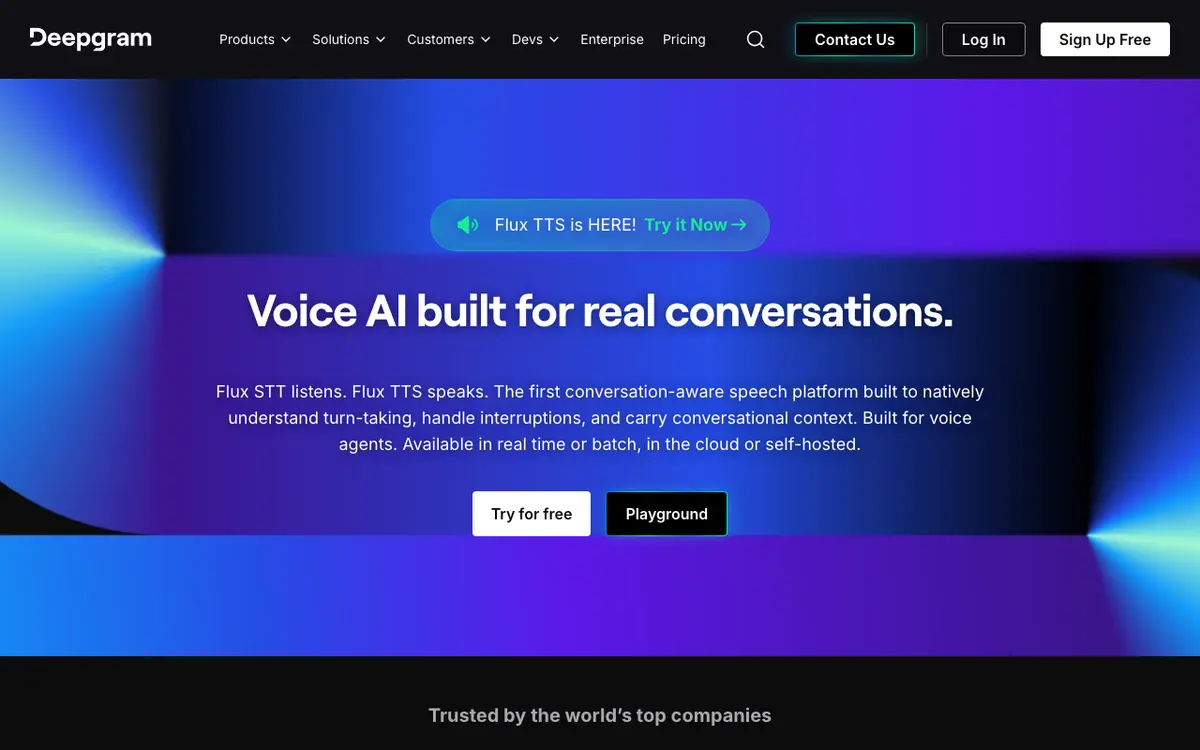
Deepgram is an enterprise AI speech platform that provides world-class speech-to-text (STT), text-to-speech (TTS), and real-time voice agent APIs. Powered by end-to-end deep learning models like Nova-2 and Aura, Deepgram delivers industry-leading accuracy, sub-250ms latency, and high cost-efficiency for processing live conversational audio.
Deepgram is the infrastructure backbone for next-generation conversational AI applications, customer service bots, meeting transcription engines, and autonomous voice agents. Its streaming WebSocket architecture allows models to transcribe noisy, multi-speaker phone audio in real time while simultaneously synthesizing natural, expressive voices with zero perceptible delay.
Why Choose Deepgram
Industry-leading Nova-2 model with highest transcription accuracy and lowest WER
Ultra-low sub-250ms streaming latency essential for conversational AI voice agents
Up to 40x faster and 3–5x cheaper than legacy cloud speech providers
Native multi-speaker diarization, smart formatting, and PII redaction
Real-time full-duplex conversational voice AI model with sub-200ms latency
4.9 / 5.0
Moshi is an open-source real-time conversational voice AI foundation model developed by Kyutai, the non-profit AI research lab based in Paris. Engineered to revolutionize human-AI verbal communication, Moshi operates on a full-duplex architecture capable of listening, thinking, and speaking simultaneously with sub-200ms end-to-end latency.
Unlike traditional voice assistants that chain separate Speech-to-Text (STT), Large Language Model (LLM), and Text-to-Speech (TTS) pipelines together, Moshi processes raw multi-stream audio natively as continuous speech tokens. This allows Moshi to understand emotional nuances, interrupt and be interrupted naturally, chuckle, whisper, and express genuine conversational timing.
Moshi is fully open-source with openly accessible weights, training recipes, and inference code, serving as a foundational milestone for research in real-time spoken language modeling and multi-modal conversational systems.
Why Choose Moshi by Kyutai
World-first open-source full-duplex voice foundation model with sub-200ms response latency
Listens and speaks simultaneously, allowing natural interruptions and conversational pacing
Expresses genuine emotional nuance including whispers, laughter, and tone modulation