Top 7 Best Prime Intellect Alternatives & Competitors in 2026
A technical evaluation of the top 7 software tools matching the core capabilities of Prime Intellect. Compare side-by-side specifications, pricing models, and trade-offs.
Open-source automated development environment management for AI coding agents
4.8 / 5.0
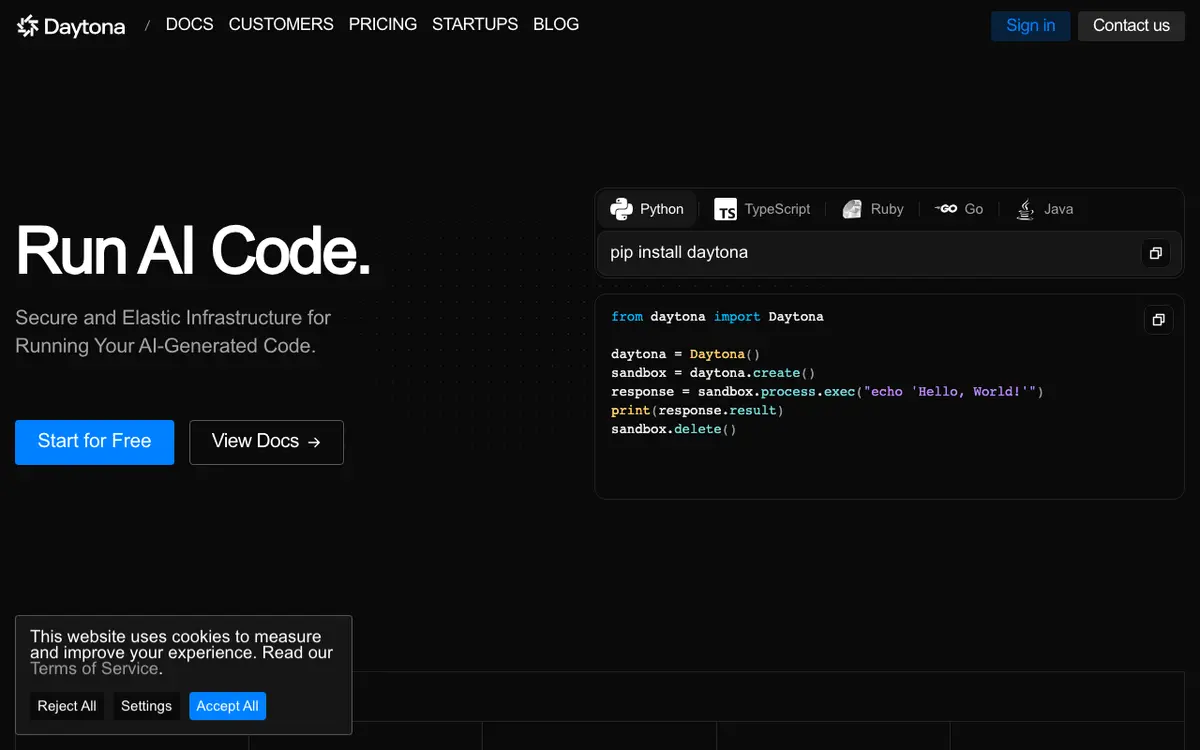
Daytona is an open-source Development Environment Management (DEM) platform that automates the provisioning, configuration, and teardown of secure coding sandboxes for developers and autonomous AI coding agents. With a single command, Daytona spins up fully configured workspaces containing all necessary SDKs, dependencies, and git configurations.
As autonomous coding agents (like Devin, Claude Code, and sweep) become mainstream, Daytona provides the standardized, isolated compute sandbox they require to run tests, compile code, and execute bash commands without risking production host environments.
Why Choose Daytona
Provides secure, isolated sandboxes for autonomous AI coding agents
One-command workspace provisioning from any git repository URL
100% open source and infrastructure agnostic (Docker, K8s, Cloud)
Native integration with VS Code, Cursor, and JetBrains IDEs
Considerations & Limitations
Requires container infrastructure (Docker or Kubernetes) for backend hosting
Production-ready RAG-as-a-service for AI developers and startups
4.7 / 5.0
Ragie is a fully managed Retrieval-Augmented Generation (RAG) backend engineered to eliminate the operational complexity of building and maintaining custom vector pipelines. It handles document parsing, semantic chunking, embedding generation, vector indexing, and hybrid re-ranking through a single high-performance API endpoint.
Instead of configuring separate chunking scripts, vector databases, and re-ranking algorithms, engineering teams connect Ragie directly to their data sources. Ragie continuously keeps embeddings synchronized and provides sub-100ms context retrieval designed specifically for conversational AI assistants and knowledge search engines.
Why Choose Ragie
Eliminates vector database and chunking infrastructure setup overhead
Advanced document layout parser handles complex tables and multi-column PDFs
Hybrid retrieval combining semantic embeddings, BM25, and cross-encoder re-ranking
Built-in multi-tenant partition security for SaaS products
Considerations & Limitations
Proprietary hosted service without a standalone offline deployment mode
High-volume enterprise indexing costs scale with total page volume
Open source LLM observability, tracing, and evaluation platform
4.8 / 5.0
Langfuse is an open-source LLM engineering and observability platform built for teams developing production-grade generative AI applications and autonomous multi-agent pipelines. It captures granular traces across token usage, prompt versions, latency bottlenecks, and retrieval accuracy, giving developers complete visibility into model behavior at runtime.
By integrating seamlessly with major AI frameworks such as LangChain, LlamaIndex, LiteLLM, and the OpenAI SDK, Langfuse eliminates the guesswork from debugging complex agent execution trees. Developers can monitor production cost metrics, identify hallucinated responses, and run rigorous continuous evaluation suites on live traffic.
Why Choose Langfuse
100% open source with complete self-hosting freedom via Docker and Helm
Native integrations with LangChain, LlamaIndex, LiteLLM, and OpenAI
Granular cost tracking and per-user token consumption breakdowns
Comprehensive LLM-as-a-judge and human scoring workflows
Considerations & Limitations
Self-hosting requires maintaining PostgreSQL and ClickHouse storage backends
Advanced multi-tenant team RBAC is restricted to enterprise tiers
High-performance vector database and similarity search engine for AI
4.9 / 5.0
Qdrant is an open-source, high-performance vector database and similarity search engine engineered in Rust for production AI systems, semantic search engines, and Retrieval-Augmented Generation (RAG) pipelines. It provides lightning-fast nearest-neighbor search with rich payload filtering and custom distance metrics.
Unlike traditional databases adapted for vectors, Qdrant was designed from day one to handle high-dimensional neural embeddings at scale. Its Rust engine provides memory-efficient vector quantization (scalar, product, and binary), allowing engineering teams to search billions of vectors on cost-effective cloud hardware.
Why Choose Qdrant
Engineered in Rust for blazing sub-10ms search latency and minimal memory footprint
Advanced vector quantization reduces RAM requirements by up to 90%
Globally distributed GPU cloud and serverless platform for AI inference and training
4.9 / 5.0
RunPod is a leading globally distributed GPU cloud and serverless computing platform engineered specifically for artificial intelligence workloads. It provides developers, AI researchers, and enterprises with on-demand access to top-tier NVIDIA GPUs (including H100, A100, L40S, and RTX 4090) at up to 80% lower cost than traditional legacy hyperscalers.
Why Choose RunPod
Up to 80% cheaper than AWS, Google Cloud, and Azure for NVIDIA GPUs
Sub-second serverless cold starts with autoscaling down to zero
1-click instant deployment templates for DeepSeek-R1, vLLM, and PyTorch
Global multi-region datacenter network with guaranteed VRAM isolation
Considerations & Limitations
Spot instance availability varies during peak enterprise compute hours
Requires familiarity with Docker containers or SSH workflows for custom stacks
Next-generation reactive Python notebook with built-in AI copilot
4.9 / 5.0
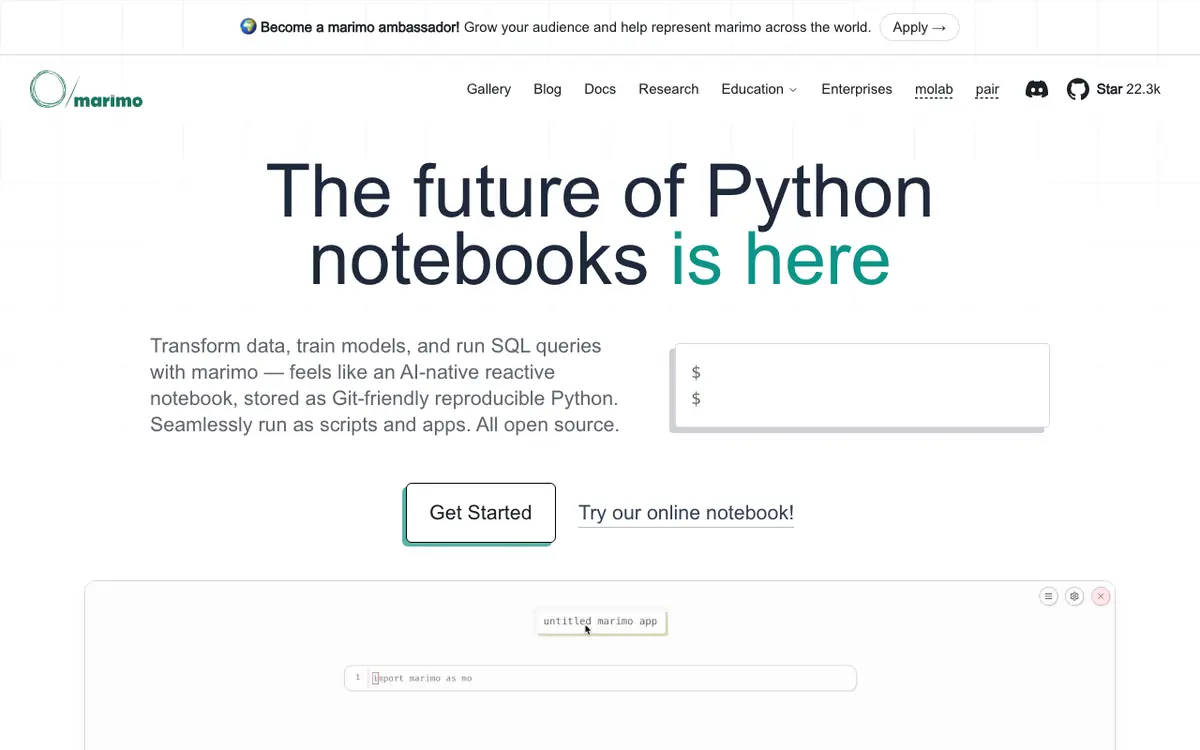
Marimo is a modern, open-source reactive Python notebook that solves the reproducibility and out-of-order execution nightmares of traditional Jupyter notebooks. Designed for data scientists, ML engineers, and researchers, Marimo guarantees that notebook state is always consistent by treating code cells as a Directed Acyclic Graph (DAG).
When you modify a variable or code cell in Marimo, all dependent downstream cells automatically re-run instantly, eliminating hidden state bugs. Furthermore, Marimo notebooks are stored as pure, version-control-friendly Python scripts rather than messy JSON files.
With built-in AI code generation, interactive UI sliders, instant conversion into shareable web apps, and native SQL query cells, Marimo represents the state-of-the-art computational notebook for 2026.
Why Choose Marimo
100% Free and open-source (Apache 2.0) with zero telemetry lock-in
Reactive DAG execution guarantees deterministic, reproducible state
Stored as clean, Git-diffable pure Python `.py` scripts instead of JSON
Built-in interactive UI components that turn notebooks into web applications
Considerations & Limitations
Requires understanding reactive dataflow principles compared to linear Jupyter